Description
Overview
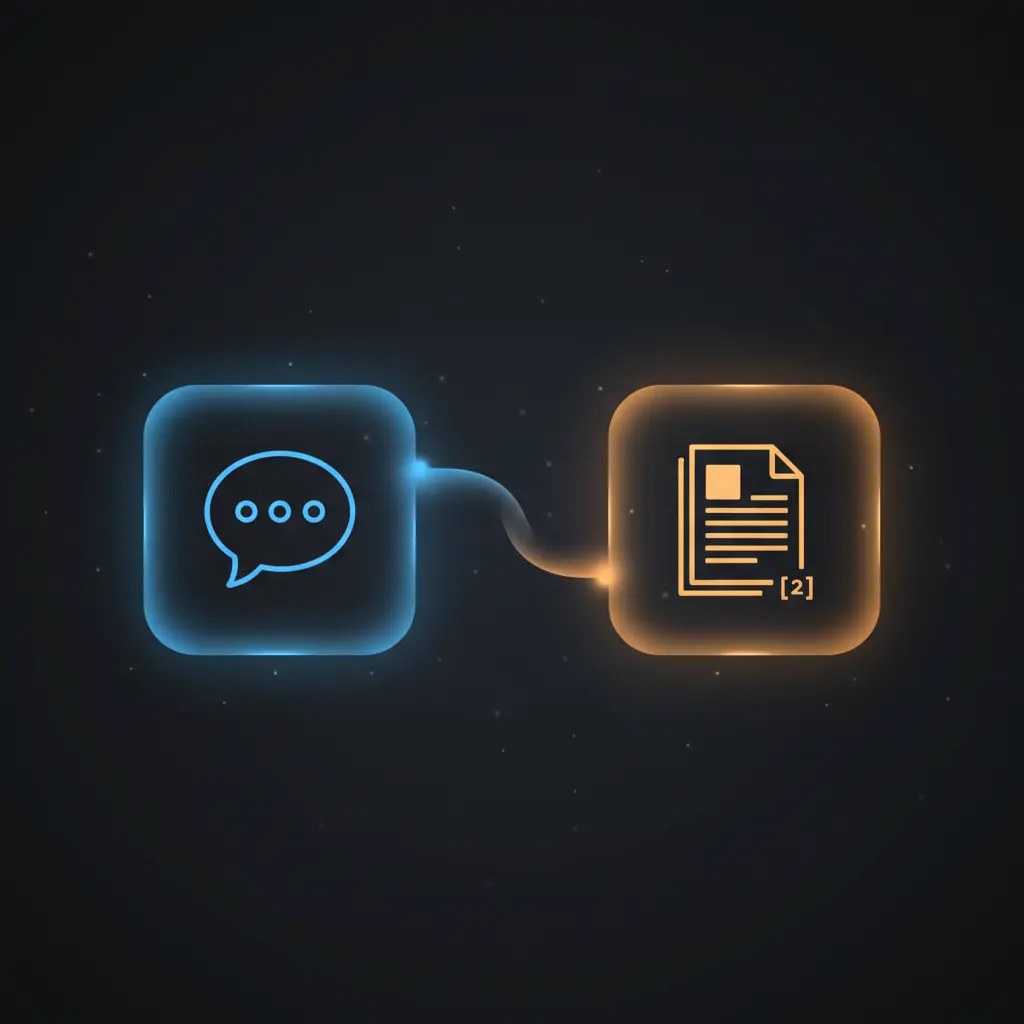
The Make OpenAI Citation for File Retrieval RAG workflow automates the generation of citations within chat responses by integrating file retrieval augmented generation (RAG) techniques. This orchestration pipeline targets developers and technical users who require precise source attributions in AI-generated content by leveraging an OpenAI assistant connected to a vector store of documents.
The workflow initiates with a chat trigger node and proceeds to enrich responses with citations extracted from file metadata, ensuring verifiable references are appended to textual outputs.
Key Benefits
- Automates citation extraction and formatting from AI-generated responses using a no-code integration.
- Aggregates and replaces citation placeholders with actual filenames for clear source attribution.
- Retrieves full conversation thread data to ensure comprehensive citation metadata is included.
- Supports output formatting in Markdown with optional conversion to HTML for flexible presentation.
Product Overview
This automation workflow starts with a chat trigger node embedded in n8n, which captures user inputs for querying an OpenAI assistant configured with a vector store containing indexed documents. The assistant performs file retrieval augmented generation (RAG), returning responses with embedded citation annotations referencing source files.
Since immediate responses may omit full citation details, the workflow uses an HTTP request node to fetch the entire conversation thread from OpenAI’s API, ensuring all citation annotations are retrieved. It then systematically splits and parses messages and annotations to isolate citation data, including file IDs.
Subsequently, the workflow performs HTTP requests to OpenAI’s file API to retrieve file metadata such as filenames, which are used to replace citation placeholders in the assistant’s output text. The final text output is formatted with inline citations in Markdown syntax, with an optional step to convert Markdown to HTML for richer formatting.
Contextual memory is maintained across interactions using a Langchain memory buffer node, enabling sustained conversational relevance. Error handling follows platform defaults, with the HTTP request node configured to continue on errors to avoid workflow interruption.
Features and Outcomes
Core Automation
This file retrieval RAG automation workflow receives user queries via a chat trigger and employs an OpenAI assistant with vector store integration to produce responses embedded with citation annotations. It applies systematic parsing and aggregation to replace citation placeholders with readable file references.
- Single-pass evaluation of citation data across multiple message iterations.
- Deterministic replacement of citation text with formatted filename references.
- Maintains conversational memory to preserve context in sequential queries.
Integrations and Intake
The orchestration pipeline integrates the OpenAI assistant configured with a vector store for file retrieval augmented generation. Authentication is handled via OpenAI API credentials. Incoming data originates from a chat trigger event containing user queries, with subsequent HTTP requests fetching thread messages and file metadata.
- OpenAI Assistant with Vector Store for semantic file retrieval.
- OpenAI API HTTP requests for conversation thread and file metadata retrieval.
- Chat trigger node for initiating workflow from user interactions within n8n.
Outputs and Consumption
The workflow outputs a text response augmented with inline citations referencing source filenames. Output is synchronous with respect to the chat interaction, delivering formatted textual content. Markdown is the default output format, with an optional transformation step to produce HTML markup.
- Formatted string output with citation placeholders replaced by filename references.
- Optional Markdown-to-HTML conversion for enhanced formatting flexibility.
- Output is structured for direct client consumption in chat interfaces.
Workflow — End-to-End Execution
Step 1: Trigger
The workflow initiates via a chat trigger node embedded in n8n’s interface, activated when a user submits a query. This node receives the input event to start the file retrieval RAG process.
Step 2: Processing
The incoming query is forwarded to the OpenAI assistant node configured with a vector store to perform semantic search over documents. Basic presence checks ensure the query payload is valid before forwarding.
Step 3: Analysis
The assistant returns a response with embedded citation annotations. The workflow then makes an HTTP request to retrieve the full conversation thread, splitting messages and citation annotations to extract file IDs. These IDs are used to fetch file metadata, enabling replacement of citation text with file references.
Step 4: Delivery
The final step aggregates all citation data and applies a code node to replace citation texts with formatted references in the assistant output. The resulting text is returned synchronously to the chat interface, optionally converted from Markdown to HTML for richer display.
Use Cases
Scenario 1
Developers require precise source attribution in AI-generated answers to comply with documentation standards. This workflow automates citation extraction from vector store files, delivering responses with embedded references. The result is verifiable AI content with clear source links in one synchronous response cycle.
Scenario 2
Data scientists need to audit AI assistant outputs for provenance. By retrieving full conversation threads and file metadata, this orchestration pipeline provides structured citations linked to source documents. This deterministic approach reduces manual validation effort and improves traceability.
Scenario 3
Technical writers want to integrate AI-generated content with references formatted in Markdown or HTML. This no-code integration formats citation annotations inline, supporting flexible output transformation. Users receive formatted, citation-rich text ready for publishing or further processing.
How to use
To use this workflow, import it into your n8n instance and configure the OpenAI API credentials with a valid key. The chat trigger node allows embedding a chat button within n8n for live user queries. No additional setup is required to connect to the OpenAI assistant configured with a vector store for file retrieval.
Upon receiving a query, the workflow automatically retrieves citation metadata, formats the output with inline references, and returns it synchronously. Optionally enable the Markdown-to-HTML node to convert output for richer text presentation.
Comparison — Manual Process vs. Automation Workflow
| Attribute | Manual/Alternative | This Workflow |
|---|---|---|
| Steps required | Multiple manual retrieval, parsing, and formatting steps | Single automated pipeline from query to formatted citation output |
| Consistency | Variable citation formatting and potential human error | Deterministic and systematic citation extraction and insertion |
| Scalability | Limited by manual processing throughput | Scales with workflow execution, supporting multiple concurrent queries |
| Maintenance | High due to manual updates and error correction | Low, relying on stable API credentials and node configurations |
Technical Specifications
| Environment | n8n automation platform |
|---|---|
| Tools / APIs | OpenAI Assistant with Vector Store, OpenAI Files API, HTTP Request node |
| Execution Model | Synchronous request–response triggered by chat input |
| Input Formats | Chat message payload via webhook trigger |
| Output Formats | Markdown text with optional HTML conversion |
| Data Handling | Transient processing; no persistent storage of input or output |
| Known Constraints | Relies on external OpenAI API availability and permissions |
| Credentials | OpenAI API key with assistant and file access |
Implementation Requirements
- Valid OpenAI API credentials configured in n8n for assistant and file access.
- Network access allowing HTTP requests to OpenAI API endpoints.
- Configured vector store within the OpenAI assistant for file retrieval functionality.
Configuration & Validation
- Verify OpenAI API credentials and assistant ID are correctly set in the workflow nodes.
- Test the chat trigger to ensure it activates the workflow upon user input in n8n.
- Validate that the workflow retrieves thread messages and file metadata, and outputs formatted citation text.
Data Provenance
- The chat trigger node initiates the workflow upon user query input.
- The OpenAI Assistant with Vector Store node performs file retrieval augmented generation.
- HTTP request nodes access OpenAI conversation threads and file metadata to extract citation details.
FAQ
How is the Make OpenAI Citation for File Retrieval RAG automation workflow triggered?
The workflow is triggered by a chat trigger node within n8n, which activates upon user input submitted via the embedded chat interface.
Which tools or models does the orchestration pipeline use?
It uses an OpenAI assistant configured with a vector store for file retrieval augmented generation, plus HTTP request nodes to retrieve thread and file metadata.
What does the response look like for client consumption?
The output is a Markdown-formatted text containing inline citations referencing source filenames, optionally convertible to HTML for richer formatting.
Is any data persisted by the workflow?
No data is persisted; all processing is transient with no long-term storage of inputs, outputs, or metadata within the workflow.
How are errors handled in this integration flow?
Error handling relies on n8n platform defaults; HTTP request nodes are configured to continue execution on errors to prevent workflow interruption.
Conclusion
The Make OpenAI Citation for File Retrieval RAG workflow provides a deterministic and automated method to append verifiable source citations to AI assistant responses using file retrieval augmented generation. It systematically retrieves and aggregates citation data from conversation threads and file metadata, replacing placeholders with formatted references. The workflow supports Markdown output with optional HTML conversion and maintains conversational context via memory buffering. This solution depends on stable OpenAI API access and does not persist data, ensuring transient and secure processing. It offers a precise, low-maintenance approach to integrate citation management within AI-driven chat applications.











Reviews
There are no reviews yet.