Description
Overview
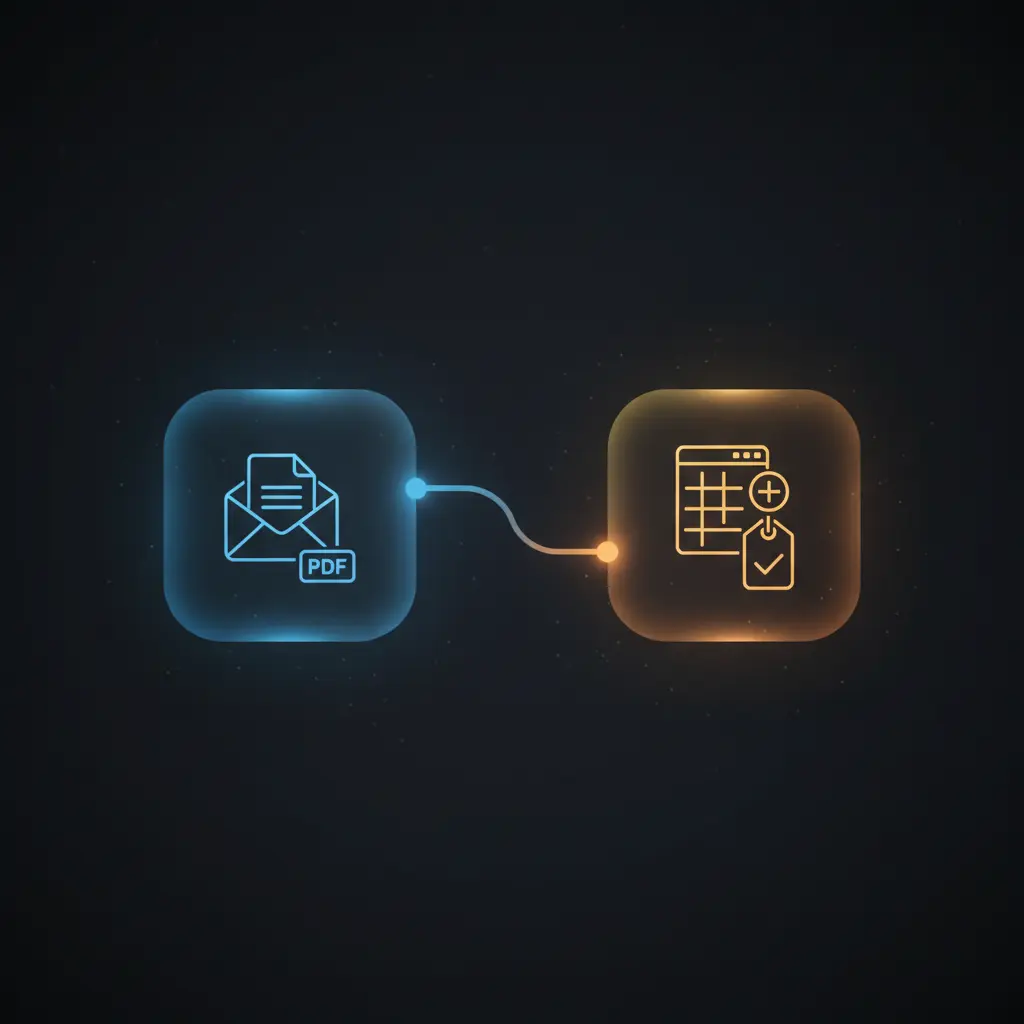
This invoice data extraction workflow automates the parsing and structuring of invoice PDFs received via email, forming an efficient automation workflow for accounts payable. Utilizing an event-driven analysis triggered by a Gmail node monitoring specific sender emails with attachments, it processes PDFs through advanced parsing and AI-driven data extraction.
Key Benefits
- Automates extraction of structured invoice data from PDF attachments with minimal manual input.
- Leverages advanced PDF parsing to preserve complex layouts such as tables and embedded objects.
- Ensures data consistency through structured output parsing with explicit JSON schema enforcement.
- Reduces duplicate processing by labeling emails after successful extraction in the orchestration pipeline.
Product Overview
This automation workflow initiates with a Gmail trigger node configured to poll every minute for emails from a designated sender containing attachments. Upon receiving an invoice PDF, the workflow validates that the attachment is a PDF and confirms the absence of an “invoice synced” label to avoid redundant processing. It then uploads the PDF to the LlamaParse API, a service specialized in extracting structured data from complex PDF documents, preserving tables and embedded figures. The workflow periodically queries the parsing job status via a switch node evaluating job states such as SUCCESS, PENDING, ERROR, or CANCELED, with a wait node to regulate polling frequency and maintain API limits.
Once parsing completes successfully, the workflow retrieves the parsed markdown invoice data and forwards it to an OpenAI GPT-3.5-turbo language model node configured with a deterministic prompt to extract key invoice fields. The extracted information is then validated and formatted by a structured output parser enforcing a detailed JSON schema that includes invoice dates, supplier and customer details, VAT numbers, line items, and pricing subtotals. The structured data is appended to a Google Sheets document for financial reconciliation. Finally, the workflow applies an “invoice synced” label to the original email to mark process completion. The entire process is synchronous with respect to invoice extraction and asynchronous in job status polling, ensuring reliable data flow without manual intervention.
Features and Outcomes
Core Automation
This automation workflow ingests invoice PDFs from email attachments and uses event-driven analysis to extract structured data via AI and advanced parsing. It applies conditional logic to filter relevant emails and employs deterministic branches for job status evaluation.
- Single-pass evaluation of invoice data extraction using GPT-3.5-turbo and schema validation.
- Conditional branching based on parsing job status to handle asynchronous processing.
- Automated labeling to prevent duplicate invoice processing in shared inbox environments.
Integrations and Intake
The orchestration pipeline integrates with Gmail for email triggers, LlamaParse API for PDF to markdown conversion, OpenAI GPT for AI-driven data extraction, and Google Sheets for data storage. Authentication methods include OAuth2 for Gmail and Google Sheets, and HTTP header authentication for LlamaParse.
- Gmail node filters emails by sender and attachment presence for intake.
- LlamaParse API processes PDFs with multipart-form-data upload and authenticated requests.
- Google Sheets API appends structured invoice data for reconciliation and tracking.
Outputs and Consumption
Extracted invoice data is output as structured JSON parsed against a predefined schema, ensuring type accuracy and nested object support. Data is synchronously appended to a Google Sheets document for further financial reconciliation workflows.
- Structured JSON output with fields including invoice dates, addresses, VAT IDs, and line items.
- Output mapped and inserted as rows in Google Sheets for record-keeping.
- Original email labeled post-processing to maintain workflow state and avoid duplication.
Workflow — End-to-End Execution
Step 1: Trigger
The workflow triggers on new Gmail messages from a specific sender (“invoices@paypal.com”) with attachments, polling the inbox every minute. It downloads attachments and extracts email labels for processing qualification.
Step 2: Processing
Emails are filtered to confirm attachment MIME type as application/pdf and absence of the “invoice synced” label. If conditions are met, the PDF is uploaded to LlamaParse for advanced parsing; otherwise, processing halts for that email.
Step 3: Analysis
The parsing job status is polled repeatedly using the LlamaParse API. The workflow branches based on job status: SUCCESS proceeds to data retrieval, PENDING triggers a wait and recheck, and ERROR or CANCELED terminate the flow. Parsed markdown data is then passed to an OpenAI GPT-3.5-turbo model with a prompt designed to extract specific invoice fields.
Step 4: Delivery
Extracted data is parsed using a structured output parser to enforce an exact JSON schema. The validated data is appended to a Google Sheets spreadsheet as a new row. Finally, the workflow adds an “invoice synced” label to the source email to prevent reprocessing.
Use Cases
Scenario 1
Accounts payable teams receive numerous PDF invoices via email, requiring manual data entry. This workflow automates invoice parsing and data extraction, resulting in structured invoice records appended directly to reconciliation sheets, eliminating manual transcription errors.
Scenario 2
Finance departments need to track invoice processing status and avoid duplicate entries. Using event-driven analysis and email labeling, this pipeline ensures each invoice is processed once, reducing redundant workload and maintaining consistent financial records.
Scenario 3
Organizations require integration of complex PDF invoices containing tables and embedded data into existing accounting spreadsheets. This automation workflow leverages advanced PDF parsing and AI extraction to convert invoices into structured data, compatible with spreadsheet reconciliation.
How to use
To implement this invoice data extraction workflow, import the configuration into your n8n instance. Set up OAuth2 credentials for Gmail and Google Sheets, and HTTP header authentication for LlamaParse. Configure the Gmail trigger with the appropriate sender email and ensure the label “invoice synced” exists in your Gmail account. Activate the workflow to enable live monitoring of incoming invoice emails. Extracted structured data will be appended automatically to the specified Google Sheets document, and processed emails labeled accordingly to avoid duplication.
Comparison — Manual Process vs. Automation Workflow
| Attribute | Manual/Alternative | This Workflow |
|---|---|---|
| Steps required | Multiple manual steps including email review, PDF reading, data entry, and reconciliation. | Automated single-pass extraction triggered by email receipt, minimizing manual intervention. |
| Consistency | Prone to human error and inconsistent data formats. | Enforces structured output with JSON schema validation for consistent data extraction. |
| Scalability | Limited by manual processing capacity and human resources. | Scales with email volume and API limits, handling multiple invoices asynchronously. |
| Maintenance | Requires ongoing human oversight and corrections for errors. | Requires periodic credential updates and monitoring of API status but reduces operational risk. |
Technical Specifications
| Environment | n8n workflow automation platform |
|---|---|
| Tools / APIs | Gmail API (OAuth2), LlamaParse API (HTTP header auth), OpenAI GPT-3.5-turbo, Google Sheets API (OAuth2) |
| Execution Model | Event-driven with asynchronous polling for parsing job status |
| Input Formats | PDF invoices received as email attachments (application/pdf) |
| Output Formats | Structured JSON parsed by schema, appended as rows in Google Sheets |
| Data Handling | Transient processing with no data persistence beyond Google Sheets |
| Known Constraints | Relies on external API availability and rate limits of LlamaParse and OpenAI |
| Credentials | OAuth2 for Gmail and Google Sheets; HTTP header authentication for LlamaParse |
Implementation Requirements
- OAuth2 credentials configured for Gmail and Google Sheets APIs.
- HTTP header authentication credentials for LlamaParse API access.
- Gmail inbox with label “invoice synced” created prior to workflow activation.
Configuration & Validation
- Confirm Gmail trigger filters correctly for sender and attachment presence.
- Verify label extraction and conditional filtering logic to prevent duplicate processing.
- Test API connectivity for LlamaParse and OpenAI nodes and validate structured output parsing against JSON schema.
Data Provenance
- Trigger node: Gmail trigger monitoring incoming emails from “invoices@paypal.com”.
- Parsing nodes: HTTP request nodes interacting with LlamaParse API for PDF conversion and status polling.
- Extraction node: OpenAI GPT-3.5-turbo model invoked via LangChain node with structured output parser enforcing JSON schema.
FAQ
How is the invoice data extraction automation workflow triggered?
The workflow is triggered by a Gmail node polling every minute for emails from a specified sender with attachments, initiating processing only if the attachment is a PDF and the email lacks the “invoice synced” label.
Which tools or models does the orchestration pipeline use?
The workflow integrates Gmail for email intake, LlamaParse API for advanced PDF parsing, OpenAI’s GPT-3.5-turbo model for AI-driven data extraction, and Google Sheets for data storage, using OAuth2 and HTTP header authentication methods.
What does the response look like for client consumption?
Extracted invoice data is returned as structured JSON conforming to a detailed schema, including nested objects and arrays, and appended as rows within a Google Sheets spreadsheet for reconciliation.
Is any data persisted by the workflow?
The workflow transiently processes data during execution, with persistent storage only occurring in the Google Sheets document; no data is retained within the workflow or APIs beyond this.
How are errors handled in this integration flow?
The workflow handles parsing job status via conditional branching; errors or canceled states terminate processing for that invoice, while pending states trigger wait and retry cycles. No additional custom error retries are configured.
Conclusion
This invoice data extraction automation workflow provides a deterministic process to convert PDF invoices from email attachments into structured data entries for reconciliation. By combining Gmail triggers, advanced PDF parsing via LlamaParse, AI extraction with OpenAI GPT, and Google Sheets integration, it reduces manual effort and improves data consistency. The workflow depends on external API availability and respects service limits through controlled polling. It delivers reliable, repeatable data extraction suitable for accounts payable automation without storing data beyond the intended repository.











Reviews
There are no reviews yet.