Description
Overview
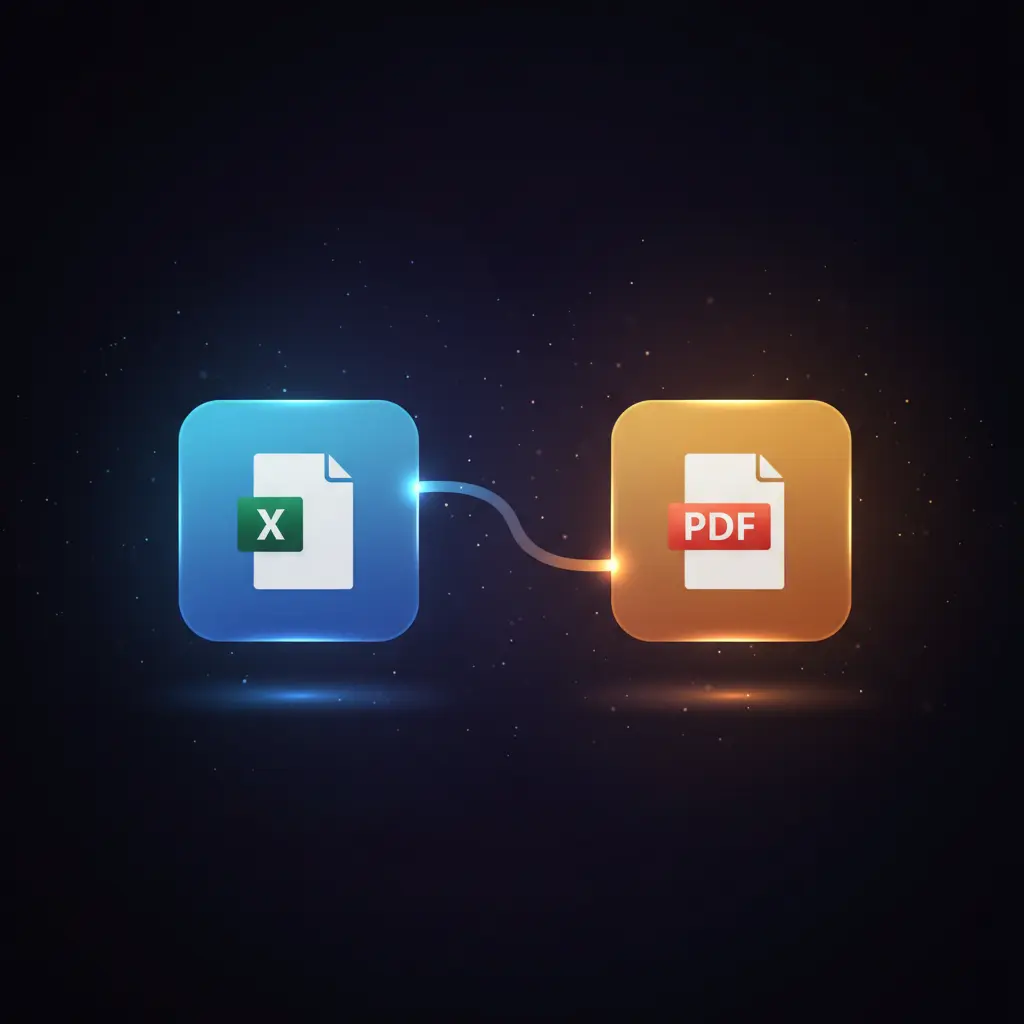
This XLSX to PDF conversion automation workflow enables users to programmatically convert Excel spreadsheet files into PDF documents within an orchestration pipeline. Designed for developers and technical operators, this no-code integration handles file download, format transformation, and local storage through a deterministic sequence triggered manually.
The workflow initiates with a manual trigger node and proceeds by downloading an XLSX file via HTTP request, then converts it using a secure, authenticated API call before saving the resulting PDF file to disk.
Key Benefits
- Automates Excel-to-PDF file format conversion using a structured orchestration pipeline.
- Supports authenticated API request ensuring secure file transformation in the integration flow.
- Downloads source XLSX files directly from a predefined URL without manual intervention.
- Saves converted PDF documents locally, enabling immediate availability for downstream processes.
Product Overview
This automation workflow begins with a manual trigger node that requires user initiation within the n8n environment. Upon activation, it downloads an XLSX file hosted at a fixed URL using an HTTP Request node configured to receive binary file data. The binary Excel file is then submitted to an external conversion API through another HTTP Request node. This node performs a POST request with multipart/form-data encoding, transmitting the file under the form field named “file”. The conversion service requires HTTP query authentication, secured via stored credentials within the platform.
The API response returns the converted PDF as binary data, which the workflow forwards to a file write node that saves the PDF to local disk storage under the fixed filename “document.pdf”. The process operates synchronously within the workflow execution context, delivering a deterministic conversion pipeline. There is no internal error handling configured beyond platform default retries or failure states. Authentication is mandatory for API access, as indicated by an internal workflow note for setup guidance.
Features and Outcomes
Core Automation
This XLSX to PDF conversion workflow processes a file download and subsequent transformation within a no-code integration pipeline. The workflow uses HTTP Request nodes for data intake and conversion, with a manual trigger initiating the sequence.
- Single-pass evaluation from XLSX fetch to PDF output without intermediate storage.
- Deterministic execution flow ensuring files are converted and saved sequentially.
- Manual trigger control allows precise execution timing and debugging.
Integrations and Intake
The workflow integrates with HTTP APIs to download and convert files. It requires HTTP query authentication for the conversion API and expects binary file data as payloads.
- HTTP Request node downloads XLSX file from a fixed external URL.
- Conversion API integration uses authenticated multipart form-data POST requests.
- Authentication managed via stored HTTP query credentials in n8n.
Outputs and Consumption
The output is a binary PDF file saved locally on the executing environment’s disk. The workflow operates synchronously, producing a deterministic file output accessible post-execution.
- PDF file saved as “document.pdf” on local storage.
- Binary data handled directly between nodes without data transformation loss.
- Output available immediately after workflow completion for downstream use.
Workflow — End-to-End Execution
Step 1: Trigger
The workflow is initiated manually via the “Test workflow” button within the n8n interface using a manual trigger node. This requires explicit user action to start the file conversion sequence.
Step 2: Processing
The downloaded XLSX file passes through the workflow without schema validation or modification. Basic presence checks are assumed, but no explicit parsing or data transformation is performed before conversion.
Step 3: Analysis
The conversion step submits the XLSX binary file to an external conversion API via a POST request with multipart form-data. Authentication is enforced using HTTP query parameters. The API returns the converted PDF file as binary data.
Step 4: Delivery
The final node writes the received binary PDF data to local disk with the filename “document.pdf”. This operation completes the synchronous request–response cycle of the workflow.
Use Cases
Scenario 1
An organization needs to convert Excel reports into PDF for standardized document distribution. This workflow automates file download and conversion, producing PDFs ready for archival or sharing without manual file handling.
Scenario 2
Developers require a repeatable pipeline to transform spreadsheet data into fixed-layout documents. The no-code integration handles authentication, file transfer, and output saving, ensuring consistent conversion results on demand.
Scenario 3
Technical teams want to integrate spreadsheet-to-PDF conversion into larger workflows. This automation acts as a modular conversion service, reliably producing PDFs from source XLSX files for downstream processing or compliance.
How to use
To operate this XLSX to PDF conversion workflow, import it into your n8n environment and ensure you have valid HTTP query credentials for the ConvertAPI service configured. Initiate the workflow manually via the interface trigger node. The workflow will download the predefined Excel file, convert it to PDF using the authenticated API call, and save the resulting PDF to local disk as “document.pdf”. Expect immediate availability of the PDF file after workflow completion for further use or integration.
Comparison — Manual Process vs. Automation Workflow
| Attribute | Manual/Alternative | This Workflow |
|---|---|---|
| Steps required | Multiple manual download, conversion, and save steps. | Single automated sequence triggered manually. |
| Consistency | Variable output depending on manual handling and tools. | Deterministic, repeatable file format conversion. |
| Scalability | Limited by manual effort and time. | Scales with workflow executions in n8n environment. |
| Maintenance | Requires manual updates for URL or tool changes. | Centralized configuration of API credentials and nodes. |
Technical Specifications
| Environment | n8n workflow automation platform |
|---|---|
| Tools / APIs | HTTP Request nodes, ConvertAPI XLSX to PDF service |
| Execution Model | Manual trigger, synchronous request–response |
| Input Formats | XLSX (Excel spreadsheet) |
| Output Formats | PDF (Portable Document Format) |
| Data Handling | Binary file transfer between nodes |
| Known Constraints | Requires valid ConvertAPI authentication for file conversion |
| Credentials | HTTP Query Auth stored in n8n credentials |
Implementation Requirements
- Valid ConvertAPI account credentials configured as HTTP query authentication in n8n.
- Network access to download the XLSX file from the configured external URL.
- Writable local disk environment where n8n is running to save the PDF output file.
Configuration & Validation
- Configure HTTP query authentication credentials within n8n for the ConvertAPI service.
- Verify network connectivity to the XLSX source URL and the ConvertAPI endpoint.
- Run the workflow manually using the trigger and confirm the creation of “document.pdf” on disk.
Data Provenance
- Manual Trigger node initiates workflow execution.
- HTTP Request nodes perform file download and authenticated conversion.
- Write Result File to Disk node outputs final PDF file as “document.pdf”.
FAQ
How is the XLSX to PDF conversion automation workflow triggered?
The workflow is triggered manually via a manual trigger node in the n8n interface, requiring explicit user initiation.
Which tools or models does the orchestration pipeline use?
The pipeline uses HTTP Request nodes to download files and perform authenticated API conversion calls to the ConvertAPI service.
What does the response look like for client consumption?
The response is a binary PDF file saved locally as “document.pdf”, accessible immediately after workflow completion.
Is any data persisted by the workflow?
The only persisted data is the PDF file written to local disk; no other data is stored within the workflow itself.
How are errors handled in this integration flow?
The workflow relies on n8n’s default error handling; no custom retry or backoff logic is configured.
Conclusion
This XLSX to PDF conversion workflow offers a methodical approach to automate file format transformation within an integration pipeline. It delivers reliable and deterministic conversion results by combining manual initiation, authenticated API interaction, and local file storage. The workflow requires valid ConvertAPI credentials to function, representing a dependency on external API availability. Overall, this solution facilitates consistent document conversion while minimizing manual handling and ensuring secure processing.
















Reviews
There are no reviews yet.