Description
Overview
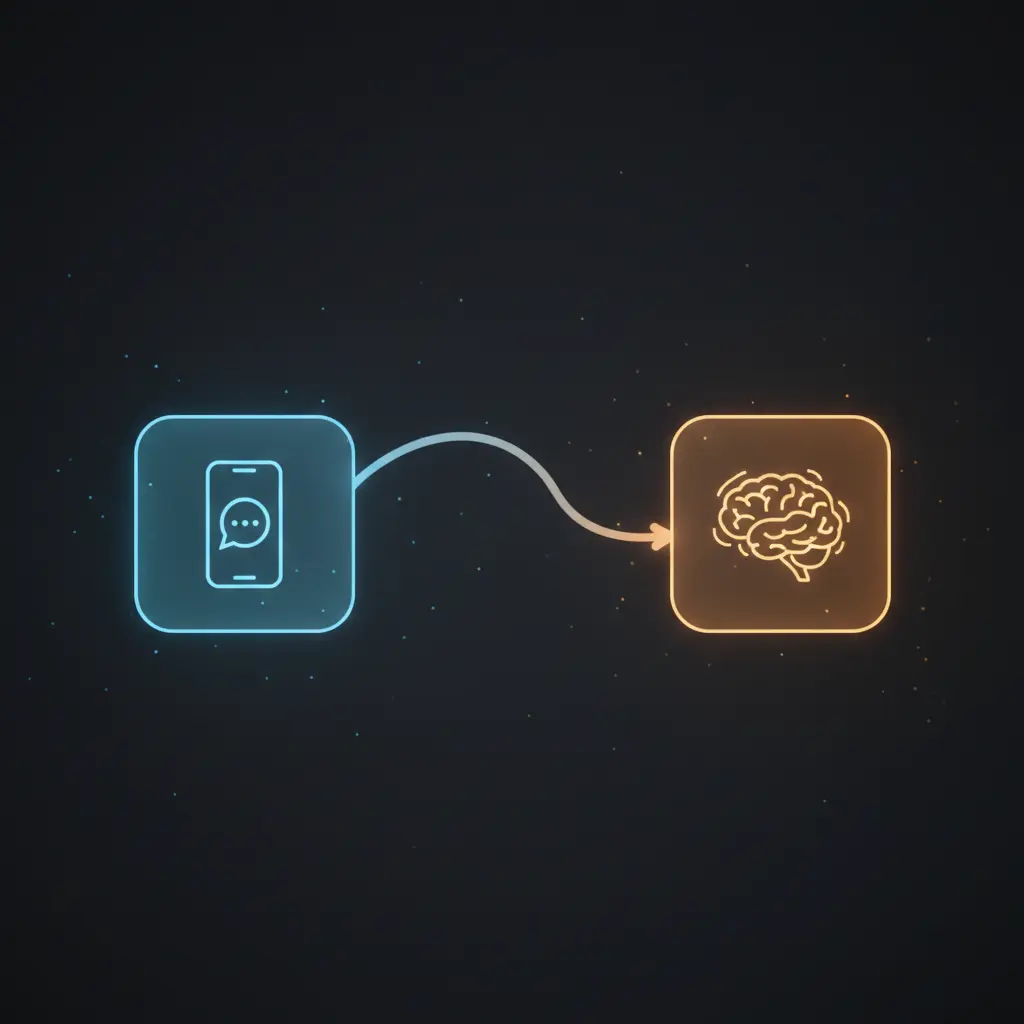
This WhatsApp message processing automation workflow is designed to handle multi-format messaging via an orchestration pipeline that integrates AI-powered analysis. It targets developers and automation engineers seeking to process WhatsApp text, audio, video, and image messages with deterministic AI-driven transformation and response generation. The workflow employs a WhatsApp Trigger node to initiate processing upon receipt of incoming messages.
Key Benefits
- Automates multi-format WhatsApp message handling including text, audio, video, and images.
- Utilizes AI transcription and description models for audio and video content analysis.
- Processes images with AI-based content explanation and visible text transcription.
- Maintains conversational context using session-based memory buffers for coherent dialogue.
- Generates accurate, succinct AI-driven responses tailored to the message content.
Product Overview
The WhatsApp message processing automation workflow begins by triggering on incoming WhatsApp messages through the WhatsApp Trigger node, which listens specifically for message updates. Upon activation, it splits the message payload into individual message components using a Split Out node. These parts are routed via a Switch node that classifies messages into audio, video, image, or text types. For audio and video messages, the workflow retrieves media URLs using dedicated WhatsApp media nodes, downloads the media files with HTTP Request nodes authenticated by WhatsApp API credentials, and forwards the content to Google Gemini multimodal AI models for transcription or description. Image messages are downloaded and analyzed with GPT-4o powered nodes that provide detailed explanations and transcribe any visible text. Text messages are passed through a summarization node to condense content for efficient AI agent comprehension. The workflow consolidates message metadata, including type, textual content, sender information, and captions, preparing structured input for an AI Agent node. This agent leverages general knowledge capabilities and an integrated Wikipedia tool to generate succinct, factual responses. Session-based window buffer memory keyed by sender identifiers preserves conversational context across interactions. The final step dispatches the AI-generated response back to the WhatsApp user using a WhatsApp send message node. The workflow operates synchronously with real-time inbound message processing and response generation. Error handling and retries rely on platform defaults, and API credentials secure WhatsApp and Google Gemini integrations.
Features and Outcomes
Core Automation
This WhatsApp message processing orchestration pipeline accepts messages as input and deterministically routes them based on message type using a Switch node. Media retrieval nodes obtain URLs for audio, video, and image content, which are then downloaded for AI analysis.
- Single-pass evaluation ensuring each message type is processed in its dedicated branch.
- Deterministic routing eliminates ambiguity in message handling and categorization.
- Session-based memory buffer supports stateful conversation management.
Integrations and Intake
The workflow integrates with WhatsApp APIs using OAuth credentials for message triggering and media access. Google Gemini multimodal AI models perform transcription and description tasks for audio and video inputs, authenticated via API keys. GPT-4o based language models analyze images and summarize text.
- WhatsApp Trigger node captures inbound messages and metadata.
- Google Gemini HTTP request nodes transcribe audio and describe video content.
- GPT-4o based nodes provide image explanation and text summarization.
Outputs and Consumption
The workflow outputs AI-generated text responses tailored to the user’s message content. Responses are delivered synchronously via the WhatsApp send node, using the sender’s phone number as the recipient address. Output fields include the generated text response and relevant conversational context.
- Text responses formatted for direct WhatsApp message sending.
- Synchronous request-response model ensures immediate reply delivery.
- Response content includes AI-generated summaries, transcriptions, or descriptions based on input type.
Workflow — End-to-End Execution
Step 1: Trigger
The workflow initiates on receipt of a WhatsApp message via the WhatsApp Trigger node configured to listen for message update events. This node captures the full message payload, including sender information and media identifiers.
Step 2: Processing
The incoming payload is split into individual message parts using a Split Out node. Each message is routed through a Switch node that directs processing based on message type: audio, video, image, or text. Basic presence checks ensure media IDs exist before proceeding to media retrieval nodes.
Step 3: Analysis
Audio and video messages are downloaded using authenticated HTTP requests and analyzed via Google Gemini multimodal models for transcription and description. Images are passed to GPT-4o powered explanation nodes that also transcribe visible text. Text messages undergo summarization using GPT-4o summarizer nodes. The AI Agent node receives structured input consolidating processed content and metadata, applying its system prompt to generate a factual, succinct response.
Step 4: Delivery
The AI-generated response text is sent back to the original WhatsApp sender through the WhatsApp node configured for message sending. Responses are dispatched synchronously within the same execution cycle, completing the interaction.
Use Cases
Scenario 1
A customer sends an audio inquiry via WhatsApp seeking product information. The workflow transcribes the voice note using AI, enabling the agent to understand the request and generate a precise text reply. This delivers structured, actionable responses in one synchronous cycle.
Scenario 2
A user submits a video demonstration of a technical issue. The orchestration pipeline downloads and analyzes the video using a multimodal AI model, producing a descriptive summary. The AI agent then provides a context-aware solution reply, improving support efficiency.
Scenario 3
An image containing a product label is sent via WhatsApp. The workflow extracts and explains image content and visible text, allowing the AI agent to offer detailed product insights. This enables automated, context-rich customer engagement.
How to use
To deploy this WhatsApp message processing workflow, import it into your n8n environment. Configure WhatsApp OAuth credentials for message triggers and media access, and provide Google Gemini API credentials for AI transcription and multimodal analysis. Activate the workflow to start listening for incoming WhatsApp messages. Upon receipt, the workflow automatically processes and routes messages by type, generating AI responses delivered back to the sender in real-time. Monitor execution for errors and ensure network access for API integrations. Expect deterministic, AI-enhanced message handling and response generation without manual intervention.
Comparison — Manual Process vs. Automation Workflow
| Attribute | Manual/Alternative | This Workflow |
|---|---|---|
| Steps required | Multiple manual steps including media download, transcription, and response drafting. | Automated routing, AI analysis, and response generation in a single workflow execution. |
| Consistency | Inconsistent due to human error and variable interpretation of media content. | Deterministic AI-driven processing ensures uniform handling of message types. |
| Scalability | Limited by manual processing capacity and response time. | Scales with n8n infrastructure and API limits, supporting concurrent message streams. |
| Maintenance | Requires continuous manual effort and retraining for new message types. | Centralized configuration with modular nodes reduces upkeep and enables easy updates. |
Technical Specifications
| Environment | n8n workflow automation platform |
|---|---|
| Tools / APIs | WhatsApp API (OAuth), Google Gemini multimodal AI, GPT-4o language models |
| Execution Model | Synchronous request-response with session memory buffering |
| Input Formats | WhatsApp messages: text, audio, video, image |
| Output Formats | Text responses sent via WhatsApp messaging node |
| Data Handling | Transient processing with no persistent storage; session memory buffers for context |
| Known Constraints | Relies on external API availability for WhatsApp and Google Gemini services |
| Credentials | WhatsApp OAuth, Google Gemini API key |
Implementation Requirements
- Valid WhatsApp OAuth credentials with permissions for message reading and media retrieval.
- Google Gemini API access configured with appropriate authentication tokens.
- Network connectivity allowing seamless API calls to WhatsApp and Google Gemini endpoints.
Configuration & Validation
- Import the workflow into n8n and assign WhatsApp and Google Gemini credentials to respective nodes.
- Activate the workflow and verify the WhatsApp Trigger node correctly receives inbound messages.
- Test message processing by sending various WhatsApp message types and confirming AI-generated responses.
Data Provenance
- Trigger node: WhatsApp Trigger listens for message updates.
- Media retrieval: Get Audio URL, Get Video URL, Get Image URL nodes use WhatsApp API credentials.
- AI processing: Google Gemini Audio/Video nodes and GPT-4o based Image Explainer, Text Summarizer nodes.
FAQ
How is the WhatsApp message processing automation workflow triggered?
It is triggered by the WhatsApp Trigger node configured to listen for incoming message update events, capturing new WhatsApp messages as they arrive.
Which tools or models does the orchestration pipeline use?
The workflow integrates Google Gemini multimodal AI models for transcription and video description, and GPT-4o based models for image explanation and text summarization.
What does the response look like for client consumption?
Responses are plain text messages generated by the AI Agent node and delivered synchronously back to the WhatsApp user via the WhatsApp API send message node.
Is any data persisted by the workflow?
No persistent storage is used; session-based window buffer memory temporarily maintains conversational context keyed to sender identifiers.
How are errors handled in this integration flow?
Error handling follows n8n platform defaults; the workflow does not implement explicit retry or backoff logic within nodes.
Conclusion
This WhatsApp message processing workflow provides a structured, AI-powered automation pipeline for handling diverse message formats including text, audio, video, and images. It produces consistent, factually accurate responses by leveraging state-of-the-art multimodal AI models and session memory to maintain conversational context. The workflow requires valid WhatsApp and Google Gemini API credentials and depends on external API availability for full operation. By removing manual intervention in message transcription, description, and summarization, it enhances scalability and reliability for WhatsApp chatbot implementations.









Reviews
There are no reviews yet.