Description
Overview
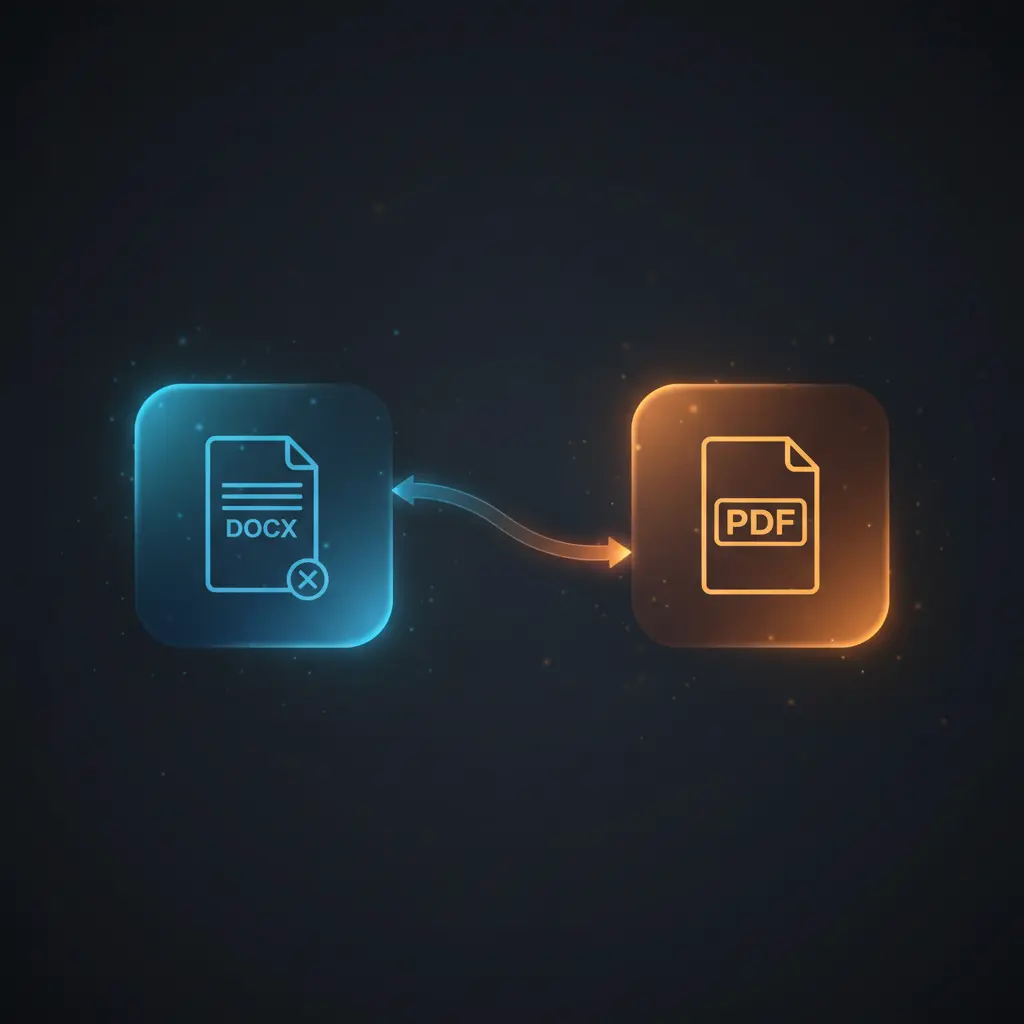
This DOCX to PDF conversion automation workflow enables streamlined document format transformation via a no-code integration pipeline. Designed for users needing reliable file format conversion, it automates the process of converting DOCX files accessible by URL into PDF documents. The workflow initiates through a manual trigger node, allowing controlled execution within the n8n environment.
Key Benefits
- Automates DOCX to PDF file conversion using an authenticated external API service.
- Utilizes a manual trigger for precise execution control of the orchestration pipeline.
- Supports multipart/form-data requests with secure query authentication credentials.
- Outputs converted PDF files as binary streams saved directly to local disk storage.
Product Overview
This automation workflow begins with a manual trigger node, requiring explicit user initiation to start the process. Upon activation, a set node configures the URL of the DOCX file to be converted. The core logic involves an HTTP Request node that sends a POST request to the ConvertAPI service endpoint for DOCX to PDF conversion. The request is formed as multipart/form-data, including the file URL as a parameter and authenticated via query authentication using a secret key credential. The HTTP Request node expects a binary file response representing the PDF output. Subsequently, the binary data is passed to a file management node that writes the PDF document to a file named “document.pdf” on local disk. The workflow includes informational nodes for authentication guidance and configuration instructions but performs no error handling beyond platform defaults. Data handling is transient, with no persistence aside from the saved output file. This synchronous workflow ensures the converted file is immediately available after execution.
Features and Outcomes
Core Automation
The no-code integration handles a single input parameter, the DOCX file URL, and executes a conversion request. The workflow’s deterministic branch is linear, progressing sequentially from trigger to file write. It leverages a multipart/form-data POST method for file submission and expects a binary stream response.
- Single-pass evaluation from input URL to saved PDF output file.
- Deterministic flow with no conditional branching or retries configured.
- Manual trigger ensures controlled and intentional execution cycles.
Integrations and Intake
The orchestration pipeline integrates with the ConvertAPI service for document format transformation. Authentication uses query parameter credentials, requiring a secret key supplied via a dedicated credential in n8n. The intake payload is minimal, consisting of a single string field containing the publicly accessible DOCX file URL.
- ConvertAPI for DOCX to PDF conversion via HTTP POST request.
- Query authentication with a secret key credential for secure API access.
- Input requires a valid URL pointing to a DOCX file accessible over the internet.
Outputs and Consumption
The workflow outputs a PDF file as a binary stream saved locally as “document.pdf”. The process is synchronous, with the file written immediately after receiving the response. Output consumption is straightforward, producing a standard PDF file compatible with common viewers.
- PDF file format delivered as binary data from the API response.
- File saved on disk with a fixed filename for consistent retrieval.
- Synchronous execution ensures immediate availability of the output file.
Workflow — End-to-End Execution
Step 1: Trigger
The workflow begins with a manual trigger node activated by the user within the n8n interface. This trigger ensures the DOCX to PDF conversion occurs only when explicitly requested, avoiding automatic or scheduled runs.
Step 2: Processing
The next node sets a configuration parameter containing the URL of the DOCX file to convert. This parameter is passed downstream without transformation or validation beyond basic presence checks.
Step 3: Analysis
The HTTP Request node constructs and sends a multipart/form-data POST request to the ConvertAPI DOCX-to-PDF endpoint. It includes the file URL as a form parameter and appends authentication credentials as a query parameter. The node expects a binary stream response representing the converted PDF file. No additional logic or threshold-based branching is applied.
Step 4: Delivery
Upon receiving the PDF binary data, the Read/Write Files from Disk node writes the data to a file named “document.pdf” on the local filesystem. This synchronous write operation completes the workflow, making the PDF available for downstream use.
Use Cases
Scenario 1
Organizations needing to convert DOCX reports to PDF for archival can automate this process. By providing a URL to the DOCX document, the workflow converts and saves the PDF locally, eliminating manual export steps and ensuring consistent output formatting in one execution cycle.
Scenario 2
Developers integrating document conversion into broader pipelines can use this automation to offload format transformation. The workflow’s predictable synchronous operation returns a PDF file ready for further processing or distribution without manual intervention.
Scenario 3
Users requiring ad hoc DOCX to PDF conversions can trigger the workflow manually via the n8n interface. This approach avoids scheduling overhead and allows flexible document conversions on demand, with the converted file reliably saved to disk for immediate access.
How to use
To utilize this DOCX to PDF conversion workflow, import it into your n8n instance. Set up a query authentication credential containing your ConvertAPI secret key. Modify the “Config” node’s `url_to_file` parameter to the desired publicly accessible DOCX file URL. Trigger the workflow manually within n8n to initiate conversion. Upon execution, the converted PDF will be saved locally as “document.pdf”. Verify the presence of this file in your configured storage location. Adjust the URL parameter as needed for different documents without changing workflow structure.
Comparison — Manual Process vs. Automation Workflow
| Attribute | Manual/Alternative | This Workflow |
|---|---|---|
| Steps required | Multiple manual steps: download, open, export, save | Single automated execution triggered manually |
| Consistency | Subject to user variability and format differences | Deterministic output via API conversion service |
| Scalability | Limited by manual capacity and user availability | Scalable via workflow repetition and automation |
| Maintenance | Ongoing manual oversight for format and tool changes | Requires minimal maintenance, mainly credential updates |
Technical Specifications
| Environment | n8n workflow automation platform |
|---|---|
| Tools / APIs | ConvertAPI DOCX to PDF conversion endpoint |
| Execution Model | Manual trigger, synchronous HTTP request–response |
| Input Formats | DOCX file accessible via HTTP URL |
| Output Formats | PDF file saved as binary stream to local disk |
| Data Handling | Transient processing; file persisted to disk only |
| Known Constraints | Requires valid public URL and ConvertAPI authentication |
| Credentials | Query authentication with secret key |
Implementation Requirements
- Access to n8n platform with ability to import and run workflows.
- Valid ConvertAPI account with secret key for query authentication.
- Publicly accessible HTTP URL pointing to the DOCX file for conversion.
Configuration & Validation
- Import the workflow into n8n and create a query authentication credential with your ConvertAPI secret key.
- Modify the `url_to_file` parameter in the “Config” node to a valid DOCX file URL accessible over HTTP.
- Trigger the workflow manually and verify that “document.pdf” is created on the local disk with the expected converted content.
Data Provenance
- Trigger node: ManualTrigger initiates execution on user action.
- HTTP Request node: Sends POST request to ConvertAPI with query authentication.
- Output: Binary PDF data saved by Read/Write Files from Disk node as “document.pdf”.
FAQ
How is the DOCX to PDF conversion automation workflow triggered?
The workflow is triggered manually via a dedicated manual trigger node within the n8n user interface, requiring explicit user initiation.
Which tools or models does the orchestration pipeline use?
The pipeline uses the ConvertAPI service accessed through an HTTP Request node, authenticated via query parameter credentials, to convert DOCX documents to PDF.
What does the response look like for client consumption?
The response is a binary data stream representing the PDF file, which the workflow writes directly to a local file named “document.pdf”.
Is any data persisted by the workflow?
Only the converted PDF file is persisted locally on disk; all other data is transient and processed in memory during workflow execution.
How are errors handled in this integration flow?
The workflow relies on n8n’s platform defaults for error handling; no explicit retry or backoff mechanisms are configured in the nodes.
Conclusion
This DOCX to PDF conversion automation workflow provides a controlled, manual-triggered pipeline for format transformation leveraging an external API. It ensures consistent synchronous output of PDF files saved locally, minimizing manual intervention beyond initial configuration. The workflow requires valid public file URLs and ConvertAPI authentication, with no built-in error recovery, relying on platform defaults. Its straightforward linear execution and clear configuration make it suitable for users seeking deterministic document conversion with minimal complexity.













Reviews
There are no reviews yet.