Description
Overview
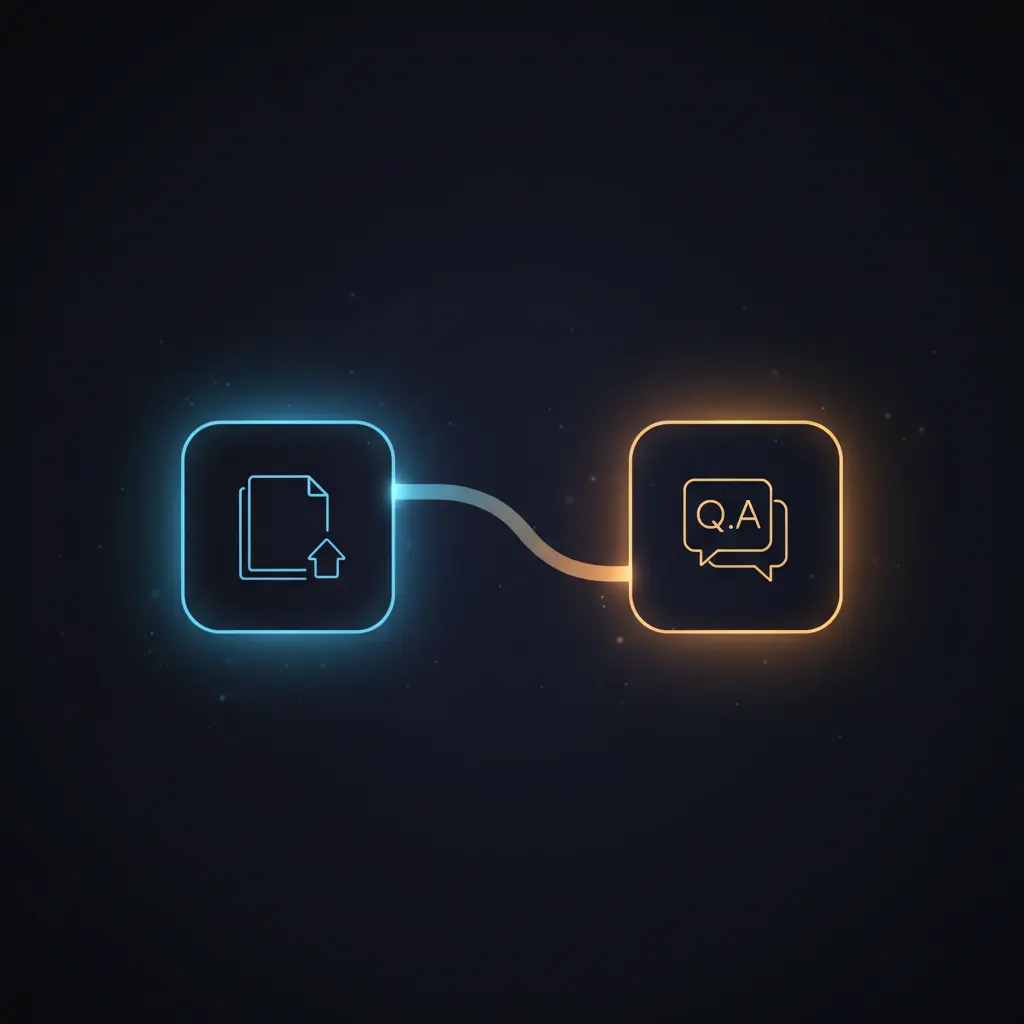
This document ingestion and vector retrieval automation workflow facilitates semantic search and interactive querying via a chatbot interface. This orchestration pipeline integrates vector embedding generation and database operations to enable natural language access to stored documents, starting with an HTTP webhook chat trigger.
Designed for developers and data engineers managing vector databases, it addresses the challenge of converting unstructured documents into searchable vector embeddings. The workflow initiates with a document download from Google Drive, leveraging the Google Drive node as a verifiable trigger point.
Key Benefits
- Automates document ingestion and vector embedding insertion into Supabase database tables.
- Enables no-code integration of OpenAI embeddings for semantic indexing and search.
- Supports interactive question answering using a chat-triggered retrieval-augmented generation pipeline.
- Maintains consistent embedding dimensions by enforcing the same embedding model during insertion and retrieval.
Product Overview
This vector document retrieval workflow begins with downloading an EPUB file from a specified Google Drive URL using the Google Drive node configured for file download. The binary document data is loaded by the Default Data Loader node employing an EPUB loader, preparing the content for downstream processing.
A Recursive Character Text Splitter node then breaks the document into smaller chunks optimized for semantic embedding, facilitating efficient vector indexing. The chunks are processed by an Embeddings OpenAI node using the “text-embedding-3-small” model to generate 1536-dimensional vector representations.
Inserted into a Supabase vector database table named “Kadampa” via the Vector Store Supabase node, the embeddings are stored alongside metadata and content text. The workflow supports updating existing vectors using a dedicated update node referencing a custom Supabase SQL function “match_documents” for similarity matching.
For retrieval, the workflow converts user queries into embeddings, fetches relevant document chunks from Supabase, and passes these to an OpenAI chat model node. The Question and Answer Chain node combines retrieval and language generation in a synchronous request-response flow triggered by incoming chat messages, allowing natural language querying of the document knowledge base.
Error handling relies on n8n platform defaults, with no explicit retry or backoff configured. The workflow emphasizes transient data handling without persistent storage outside the vector database, ensuring query results are generated on demand.
Features and Outcomes
Core Automation
This automation workflow processes document ingestion and semantic vector embedding insertion using a no-code integration pipeline. It applies recursive text splitting before embedding generation, ensuring optimized chunk sizes for accurate vector representation.
- Single-pass recursive text splitting for granular semantic chunking.
- Deterministic embedding dimension enforcement with OpenAI’s “text-embedding-3-small” model.
- Synchronous request-response chain combining retrieval and chat model answer generation.
Integrations and Intake
The workflow integrates Google Drive for document intake, Supabase as the vector storage backend, and OpenAI for embedding and language modeling. OAuth or API key authentication secures access to these services where applicable.
- Google Drive node for secure EPUB file download ingestion.
- Supabase vector database with pgvector extension for semantic storage and querying.
- OpenAI API for embedding generation and chat-based language model response.
Outputs and Consumption
Outputs consist of natural language answers generated by the OpenAI chat model, presented synchronously in response to user chat queries. The workflow returns text answers derived from top-K retrieved document vectors.
- Textual responses formatted for chat consumption.
- Top 10 relevant document chunks retrieved per query.
- Synchronous webhook response delivery enabling immediate interaction.
Workflow — End-to-End Execution
Step 1: Trigger
The workflow is initiated by the “When chat message received” node, an HTTP webhook trigger that listens for incoming chat messages. It starts the question answering sequence with an initial greeting configured in the node parameters.
Step 2: Processing
Document ingestion involves downloading an EPUB file from Google Drive, followed by loading the binary content via a dedicated EPUB loader. The text is recursively split into smaller chunks to optimize semantic embedding quality. Basic presence checks ensure the document content is processed correctly.
Step 3: Analysis
Embeddings are generated using OpenAI’s “text-embedding-3-small” model, producing fixed 1536-dimensional vectors. The workflow applies the custom Supabase SQL function “match_documents” to perform similarity searches against stored vectors, retrieving the top 10 closest matches for the user query.
Step 4: Delivery
Retrieved documents and user query embeddings are passed to an OpenAI chat model node, which generates a natural language answer. The final response is customized in a set node and returned synchronously to the webhook caller for immediate consumption.
Use Cases
Scenario 1
When a knowledge base manager needs to semantically index a new EPUB document, this automation workflow downloads the file, splits its text, generates vector embeddings, and inserts them into Supabase. This process enables fast, relevant retrieval for future queries.
Scenario 2
A developer wants to provide a chatbot interface that answers questions about stored documents. Using this orchestration pipeline, user queries are converted to embeddings, matched against the vector store, and answered by a language model in a single synchronous flow.
Scenario 3
When document content requires updating, the workflow supports upserting semantic vectors using the same embedding model and a custom Supabase update function, ensuring the vector store maintains consistency without manual database interventions.
How to use
To deploy this vector retrieval automation workflow in n8n, configure Google Drive credentials for file access and set Supabase API keys with required permissions. Ensure your Supabase instance has the pgvector extension enabled and the “Kadampa” table schema prepared as specified.
Upload documents by providing their Google Drive URLs. The workflow will automatically download, process, embed, and store document chunks. Connect the webhook URL to your chat interface to start receiving natural language queries, which will return generated answers based on stored vectors.
Expect synchronous response times dependent on API latencies. Use the provided sticky notes in the workflow for database setup instructions and embedding model consistency guidelines.
Comparison — Manual Process vs. Automation Workflow
| Attribute | Manual/Alternative | This Workflow |
|---|---|---|
| Steps required | Multiple manual steps including file download, chunking, embedding generation, and database insertion. | Fully automated end-to-end process from document download to vector insertion and querying. |
| Consistency | Prone to human error in embedding dimension matching and metadata management. | Deterministic embedding model enforcement ensures consistent vector dimensions. |
| Scalability | Limited by manual throughput and processing speed. | Scales with n8n execution environment and API rate limits, supporting batch and real-time queries. |
| Maintenance | Requires manual schema updates and database management. | Leverages reusable nodes and custom SQL functions, reducing maintenance complexity. |
Technical Specifications
| Environment | n8n automation platform with access to Google Drive, OpenAI API, and Supabase instance |
|---|---|
| Tools / APIs | Google Drive API, OpenAI Embeddings and Chat APIs, Supabase vector store with pgvector extension |
| Execution Model | Synchronous request-response for chatbot queries |
| Input Formats | EPUB file via Google Drive download |
| Output Formats | Natural language text responses in chat format |
| Data Handling | Transient processing with vector embeddings stored in Supabase table |
| Known Constraints | Embedding dimension must match between insertion and retrieval (1536 dimensions) |
| Credentials | Google Drive OAuth, OpenAI API key, Supabase API key with JWT authorization |
Implementation Requirements
- Google Drive OAuth credentials with permission to download target EPUB files.
- Supabase project with pgvector extension enabled and configured vector table.
- OpenAI API key for embedding generation and chat language model access.
Configuration & Validation
- Verify Google Drive node can successfully download the specified EPUB file using provided credentials.
- Confirm Supabase table “Kadampa” exists with columns for embedding (VECTOR(1536)), metadata (JSONB), and content (TEXT).
- Test chat webhook trigger and ensure queries return relevant answers generated from stored document vectors.
Data Provenance
- Trigger: “When chat message received” node initiates the workflow via HTTP webhook.
- Document ingestion: “Google Drive” node downloads EPUB files; “Default Data Loader” loads binary content.
- Embedding and retrieval: OpenAI embedding nodes and “Vector Store Supabase” nodes manage vector storage and querying.
FAQ
How is the document ingestion and vector retrieval automation workflow triggered?
The workflow is triggered by an HTTP webhook via the “When chat message received” node, which listens for incoming chat queries to start the retrieval-augmented generation pipeline.
Which tools or models does the orchestration pipeline use?
The workflow integrates Google Drive for document download, OpenAI’s “text-embedding-3-small” model for embeddings, Supabase with pgvector for vector storage, and OpenAI chat models for answer generation.
What does the response look like for client consumption?
The response is a natural language text answer generated synchronously by the OpenAI chat model, based on the top retrieved document chunks from the vector database.
Is any data persisted by the workflow?
Only vector embeddings and associated metadata are persisted in the Supabase vector database; the rest of the data is processed transiently within the workflow.
How are errors handled in this integration flow?
Error handling follows n8n platform defaults; there are no explicit retry or backoff mechanisms configured in this workflow.
Conclusion
This vector document retrieval automation workflow provides a structured method to ingest, embed, store, and query documents semantically via a chatbot interface. It delivers deterministic embedding dimension consistency and synchronous response generation using OpenAI and Supabase technologies. While the workflow relies on external API availability for Google Drive and OpenAI services, it reduces manual steps and errors in semantic indexing and querying. Its modular design supports document insertion, updating, and natural language interaction, enabling scalable and maintainable vector search applications.











Reviews
There are no reviews yet.