Description
Overview
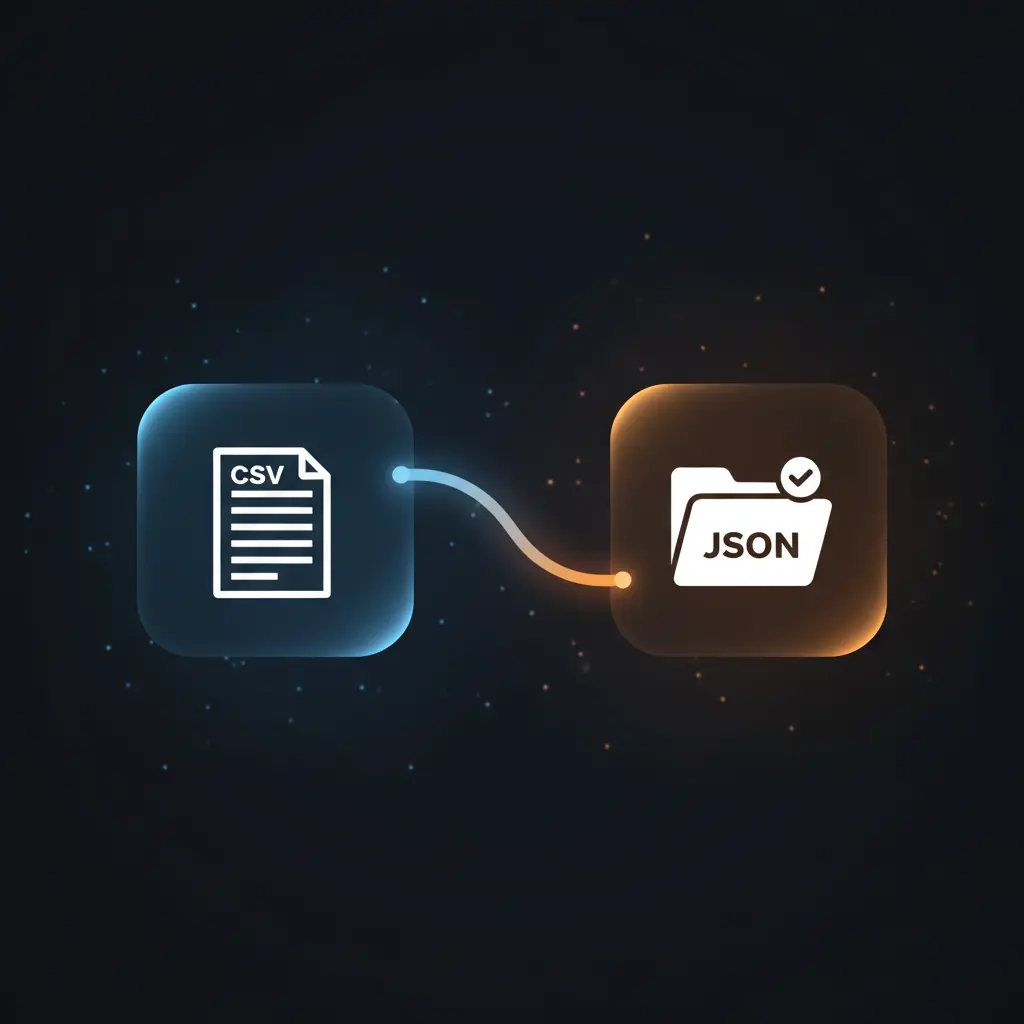
This CSV to JSON file conversion automation workflow is designed for users needing a reliable spreadsheet data transformation pipeline. It provides a deterministic process to convert CSV spreadsheet inputs into structured JSON outputs by leveraging a manual trigger and file system nodes within a no-code integration framework.
The workflow initiates with a manual trigger node and reads a CSV file as binary data, ensuring controlled execution without external event dependencies.
Key Benefits
- Enables direct conversion from CSV spreadsheet files to JSON format without intermediary tools.
- Utilizes a manual trigger allowing precise control over when the automation workflow runs.
- Maintains data integrity by processing raw binary file input before parsing.
- Outputs well-structured JSON files ready for further processing or integration.
Product Overview
This automation workflow starts by waiting for a manual trigger action within the n8n interface, allowing the user to initiate conversion on demand. Upon activation, it reads the specified CSV file from the local filesystem as binary data using a dedicated read binary file node. The raw binary data is then parsed by a spreadsheet file node configured to interpret CSV content, converting rows and columns into structured JSON objects. After parsing, the JSON data is converted back into binary format to comply with the subsequent write binary file node’s requirements. Finally, the workflow writes the binary JSON data to a new file path on the filesystem, producing a JSON file that faithfully represents the original CSV spreadsheet. The entire pipeline operates synchronously on manual execution without external triggers or asynchronous queuing. Error handling is managed by the platform’s default mechanisms, as no custom retry or backoff strategies are implemented. No persistent data storage occurs outside of the written JSON file, ensuring transient processing within the workflow runtime.
Features and Outcomes
Core Automation
This no-code integration pipeline accepts a CSV spreadsheet file as input and deterministically converts it into a JSON file format. Using nodes like “Read Binary File” and “Spreadsheet File,” it executes a single-pass evaluation of the file data before final output preparation.
- Single-pass file read and parse ensures minimal data transformation errors.
- Manual trigger controls workflow execution timing precisely.
- Binary-to-JSON parsing and back to binary conversion preserves data fidelity.
Integrations and Intake
The orchestration pipeline integrates with the local filesystem to intake the CSV file and write the JSON output. It does not use external APIs or authentication methods, relying solely on file path configurations. The expected payload is a CSV file read as binary data.
- Reads local CSV files using the Read Binary File node for raw data ingestion.
- Parses CSV content into JSON objects via Spreadsheet File node.
- Writes JSON output as binary data to the filesystem with Write Binary File node.
Outputs and Consumption
The workflow outputs a JSON file stored locally, containing structured JSON representations of the original CSV rows and columns. The file write operation is synchronous, completing on workflow execution.
- JSON output file with spreadsheet data organized as JSON objects.
- Synchronous file write ensures completion before workflow termination.
- Output file path configurable within the Write Binary File node parameters.
Workflow — End-to-End Execution
Step 1: Trigger
The workflow is initiated manually via the “On clicking ‘execute'” manual trigger node within the n8n interface. This trigger does not depend on external events or incoming requests, allowing user-controlled execution.
Step 2: Processing
After triggering, the workflow reads the CSV file as binary data from a fixed filesystem path using the Read Binary File node. This binary data passes unchanged to the Spreadsheet File node, which parses the CSV format into JSON objects representing each spreadsheet row and column.
Step 3: Analysis
The workflow does not perform heuristic analysis or conditional logic beyond file format parsing. The Spreadsheet File node deterministically converts the input CSV into JSON without transformation rules or thresholds configured.
Step 4: Delivery
The resulting JSON data is converted to binary format to meet the Write Binary File node’s input requirements. The workflow then writes the binary JSON content to a specified path on the filesystem, completing the conversion process synchronously.
Use Cases
Scenario 1
An operations team needs to convert periodic CSV export data into JSON format for ingestion by internal APIs. This automation workflow provides a manual trigger to execute conversions on demand, outputting structured JSON files compatible with downstream systems.
Scenario 2
A data engineer requires a repeatable process to transform local spreadsheet files into JSON for validation and reporting pipelines. The CSV to JSON automation workflow ensures consistent parsing and output without manual intervention beyond triggering.
Scenario 3
Developers creating integration tests need to generate JSON fixtures from CSV data sets. This workflow enables synchronous conversion of CSV spreadsheets into JSON files, facilitating test data preparation within a no-code environment.
How to use
To utilize this CSV to JSON conversion workflow, import it into your n8n environment and configure the file paths for the CSV input and JSON output nodes according to your filesystem. After setup, trigger the workflow manually by clicking “execute” in the n8n interface. The workflow reads the CSV file, parses it into JSON, converts to binary format, and writes the JSON file to the specified location. Expect a JSON file output that mirrors the original spreadsheet structure, ready for further processing or integration.
Comparison — Manual Process vs. Automation Workflow
| Attribute | Manual/Alternative | This Workflow |
|---|---|---|
| Steps required | Multiple manual steps involving file opening, parsing, and saving in new format. | Single manual trigger initiates automated multi-node conversion. |
| Consistency | Subject to human error in data handling and format conversion. | Deterministic parsing and file writing reduce errors. |
| Scalability | Limited by manual workload and error rate with increased file volume. | Scales with workflow executions but requires manual trigger per run. |
| Maintenance | Requires manual upkeep of conversion procedures and tool updates. | Low maintenance, configured once within n8n environment. |
Technical Specifications
| Environment | n8n workflow automation platform with local filesystem access |
|---|---|
| Tools / APIs | Manual Trigger, Read Binary File, Spreadsheet File, Move Binary Data, Write Binary File nodes |
| Execution Model | Synchronous manual trigger with sequential node execution |
| Input Formats | CSV spreadsheet file read as binary data |
| Output Formats | JSON file written as binary data |
| Data Handling | Transient in-memory processing with persistent JSON file output |
| Known Constraints | Manual execution required; no automated scheduling or external triggers |
| Credentials | None required; accesses local filesystem via configured file paths |
Implementation Requirements
- Access to the local filesystem paths for reading the CSV and writing the JSON files.
- Configured n8n instance with nodes for manual trigger, file reading, spreadsheet parsing, binary data handling, and file writing.
- Appropriate permissions to read and write files at specified locations.
Configuration & Validation
- Verify that the Read Binary File node’s file path points to an existing CSV file with correct permissions.
- Ensure the Spreadsheet File node is configured to parse CSV format correctly without additional options.
- Confirm the Write Binary File node’s file path is writable and that binary data conversion occurs as expected.
Data Provenance
- Workflow triggered by the manual trigger node “On clicking ‘execute'”.
- File read from local path via “Read Binary File” node as binary input.
- Data parsed using “Spreadsheet File1” node into JSON, then converted to binary by “Move Binary Data” node before final file output.
FAQ
How is the CSV to JSON file conversion automation workflow triggered?
The workflow is triggered manually by the user clicking “execute” within the n8n interface, without reliance on external event triggers.
Which tools or models does the orchestration pipeline use?
The pipeline uses n8n nodes including Manual Trigger, Read Binary File, Spreadsheet File for CSV parsing, Move Binary Data, and Write Binary File. No external models are involved.
What does the response look like for client consumption?
The workflow produces a JSON file saved locally, containing structured JSON objects that represent the original CSV spreadsheet data.
Is any data persisted by the workflow?
Only the JSON file output is persisted on the local filesystem; intermediate data within the workflow is transient.
How are errors handled in this integration flow?
Error handling relies on n8n’s default behavior; no custom retry or backoff logic is configured within this workflow.
Conclusion
This CSV to JSON file conversion workflow provides a deterministic, manual-triggered process to transform spreadsheet data into JSON format within the n8n platform. It ensures structured parsing and binary data handling before outputting a JSON file to the local filesystem. The workflow depends on manual execution and local file access, which may limit automation in fully event-driven environments. However, it delivers dependable data transformation outcomes with minimal maintenance requirements and clear configuration parameters.
















Reviews
There are no reviews yet.