Description
Overview
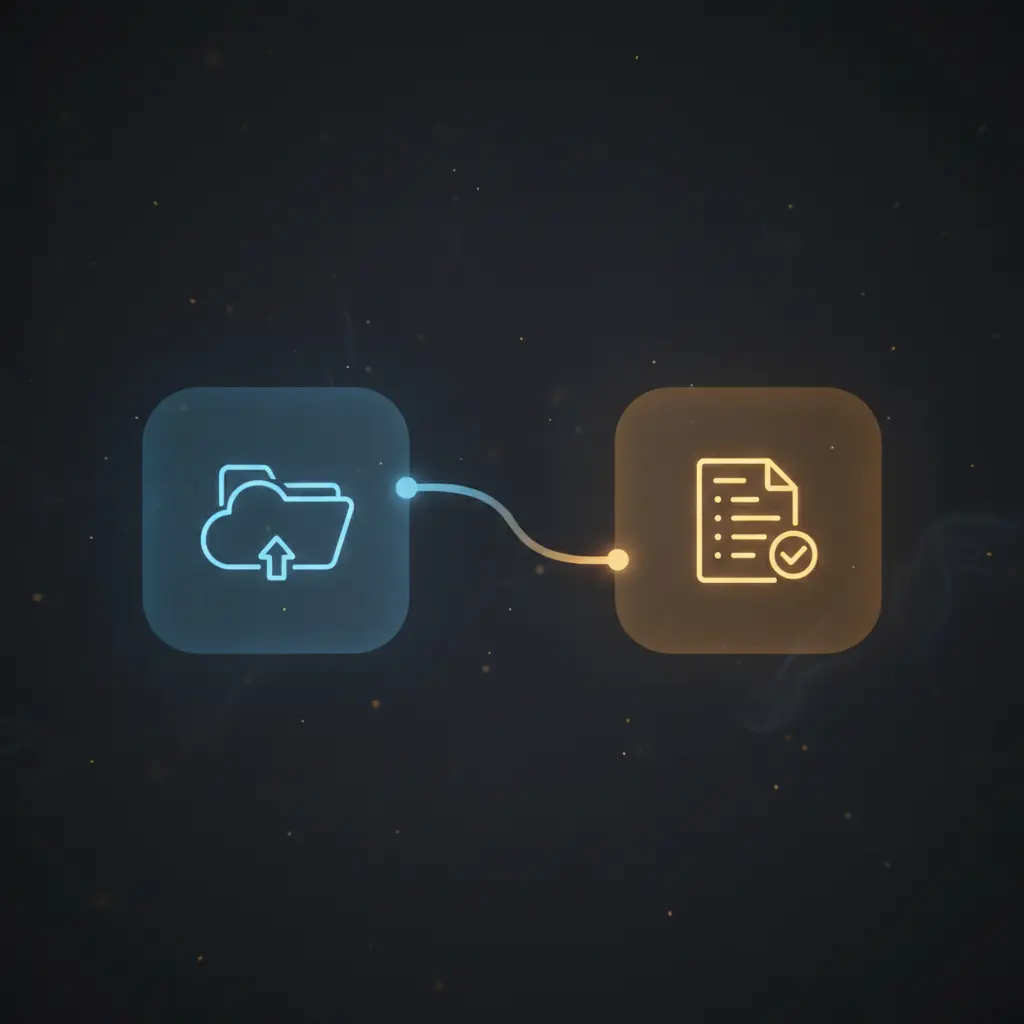
This transcription automation workflow is designed to convert audio files into structured summaries automatically. This orchestration pipeline uses a Google Drive trigger to detect new audio uploads and initiates transcription and summarization processes, enabling efficient no-code integration for audio content management.
Targeted at teams and individuals managing recorded audio, it solves the problem of manual transcription and summarization by delivering a deterministic output: a detailed JSON summary stored in Notion. The workflow employs a Google Drive Trigger node configured to poll a specific folder every minute for new files.
Key Benefits
- Automates transcription of audio files uploaded to a designated Google Drive folder.
- Generates structured summaries with detailed elements including action items and sentiment analysis.
- Integrates with Notion to store summaries as organized pages for easy retrieval and collaboration.
- Uses no-code integration to reduce manual intervention and streamline audio content workflows.
Product Overview
This workflow begins with a Google Drive Trigger node that monitors a specific folder named “Recordings” for new audio files, polling every minute for changes. Upon detecting a new file, the Google Drive node downloads the audio file as binary data using the file’s unique ID and original filename. The binary audio data is then sent to the OpenAI Whisper node, which transcribes the audio into text. Following transcription, the workflow invokes the OpenAI GPT-4 Turbo model to generate a detailed, structured JSON summary. This summary includes fields such as title, main points, action items with ISO 601 date tags, sentiment analysis, and related topics, strictly adhering to a predefined JSON schema. Finally, the Notion node creates a new page in a configured workspace, setting the page title and inserting content blocks with the summary text. The entire process is synchronous within the workflow execution and relies on OAuth2 credentials for Google Drive and Notion integration. Error handling defaults to platform behavior without explicit retry or backoff mechanisms defined.
Features and Outcomes
Core Automation
This automation workflow accepts audio file uploads as input and applies transcription and summarization criteria using AI models. The process includes deterministic branches where the transcript text is converted into a structured JSON summary by the GPT-4 node.
- Single-pass evaluation from audio input to structured JSON summary output.
- Deterministic data transformation adhering to a strict JSON schema for summaries.
- Automated handoff between transcription and summarization nodes without manual intervention.
Integrations and Intake
The workflow integrates with Google Drive for file intake and Notion for output storage, using OAuth2 credentials for authentication. It processes events triggered by new file creation in a specific folder, managing binary audio payloads and JSON summary content.
- Google Drive Trigger for event-driven detection of new audio files.
- OpenAI Whisper API for audio transcription using audio resource operation.
- Notion API for creating new pages with structured summary content.
Outputs and Consumption
Outputs include a JSON-formatted summary containing multiple categorized keys and a Notion page with the summary text. The workflow operates synchronously, delivering the transcription and summary in one execution cycle.
- Structured JSON summary with fields such as title, main points, and sentiment.
- Notion page creation with heading and text blocks representing the summary.
- Synchronous flow ensuring immediate availability of the transcription results.
Workflow — End-to-End Execution
Step 1: Trigger
The workflow initiates via a Google Drive Trigger node that polls a specific folder named “Recordings” every minute. It listens exclusively for file creation events, activating the workflow when a new audio file is uploaded to the folder.
Step 2: Processing
After triggering, the Google Drive node downloads the detected audio file as binary data. The workflow performs basic presence checks on the file ID and filename; no additional validation or transformation is applied before transcription.
Step 3: Analysis
The downloaded audio is sent to the OpenAI Whisper node for transcription into text. The resulting transcript is then passed to the OpenAI GPT-4 Turbo node, which applies a prompt instructing it to generate a structured JSON summary. This step enforces strict JSON formatting with comprehensive fields, including date-tagged action items and sentiment analysis.
Step 4: Delivery
The final JSON summary output is parsed and used to create a new page in Notion. The page title is set from the summary’s title field, and content blocks include a heading and summary text. This storage step completes the workflow by making the summarized content accessible in Notion.
Use Cases
Scenario 1
Organizations recording meetings face challenges in manually transcribing and summarizing audio. This workflow automates detection of uploaded meeting recordings, transcribes the audio via Whisper, and generates structured summaries using GPT-4. The result is a consistent archive of meeting insights accessible in Notion.
Scenario 2
Content creators producing interviews need efficient transcription and summarization to extract key points. This orchestration pipeline automatically processes new interview audio files, producing detailed JSON summaries with action items and sentiment. Summaries are stored in Notion, facilitating content review and repurposing.
Scenario 3
Educational institutions often record lectures requiring transcription and knowledge extraction. Using this automation workflow, uploaded lecture audio is transcribed, summarized into structured data, and archived in Notion. This enables educators and students to access organized lecture summaries without manual effort.
How to use
To deploy this transcription automation workflow in n8n, first configure OAuth2 credentials for Google Drive and Notion integrations. Set the Google Drive Trigger to monitor the target folder for new audio files. Configure the Notion node with the destination workspace and page ID. Once activated, the workflow runs automatically upon new audio uploads, producing transcriptions and structured summaries stored in Notion. Users can expect synchronous processing with immediate transcription results and detailed JSON summaries available in their Notion workspace.
Comparison — Manual Process vs. Automation Workflow
| Attribute | Manual/Alternative | This Workflow |
|---|---|---|
| Steps required | Multiple manual steps: upload, transcription, summary, document creation | Single automated pipeline triggered by new audio file upload |
| Consistency | Variable, dependent on manual transcription and summarization quality | Deterministic structured JSON output with consistent formatting |
| Scalability | Limited by human transcription capacity and time constraints | Scales with workflow automation and API resource availability |
| Maintenance | High effort for managing transcription and summary quality | Low maintenance with OAuth2 credentials and configured nodes |
Technical Specifications
| Environment | n8n workflow automation platform |
|---|---|
| Tools / APIs | Google Drive API (OAuth2), OpenAI Whisper and GPT-4 APIs, Notion API (OAuth2) |
| Execution Model | Synchronous workflow execution triggered by file creation event |
| Input Formats | Audio files uploaded to Google Drive folder (binary data) |
| Output Formats | Structured JSON summary; Notion page content blocks |
| Data Handling | Transient processing of audio and text during workflow; no persistent storage in workflow |
| Known Constraints | Requires valid OAuth2 credentials and available external APIs |
| Credentials | Google Drive OAuth2, OpenAI API key, Notion OAuth2 |
Implementation Requirements
- OAuth2 credentials for Google Drive with access to the monitored folder.
- API key or credentials for OpenAI services with Whisper and GPT-4 access.
- OAuth2 credentials for Notion with permission to create pages in the target workspace.
Configuration & Validation
- Verify Google Drive Trigger correctly polls the specified folder and detects new audio files.
- Confirm the Google Drive node downloads files by file ID with correct binary output.
- Validate OpenAI transcription and summary nodes produce expected JSON-structured summaries formatted per instructions.
Data Provenance
- Trigger node: Google Drive Trigger configured for ‘fileCreated’ event on folder “Recordings”.
- Transcription node: OpenAI Whisper audio transcription resource.
- Summary node: OpenAI GPT-4 Turbo model generating structured JSON summaries.
- Output node: Notion API creating pages with summary content blocks.
FAQ
How is the transcription automation workflow triggered?
The workflow is triggered by a Google Drive Trigger node polling a specific folder every minute for newly created audio files, initiating the process upon detection.
Which tools or models does the orchestration pipeline use?
The workflow uses OpenAI’s Whisper API for audio transcription and the GPT-4 Turbo model for generating structured JSON summaries, integrated via n8n nodes.
What does the response look like for client consumption?
The output is a JSON-formatted summary including title, main points, action items with date tags, and sentiment, stored in Notion as a new page with heading and text blocks.
Is any data persisted by the workflow?
Data is transiently processed during workflow execution; only the final structured summary is persisted in Notion. No intermediate data is stored within the workflow.
How are errors handled in this integration flow?
Error handling relies on n8n platform defaults; there are no explicit retry or backoff mechanisms configured within the workflow.
Conclusion
This transcription automation workflow provides a structured process to convert new audio files into detailed summaries stored in Notion, supporting efficient knowledge management. It ensures deterministic, well-formatted JSON output by combining Google Drive event triggers, OpenAI transcription and summarization models, and Notion integration. The workflow requires valid OAuth2 credentials and depends on the availability of external APIs. Its design focuses on automation and consistency, reducing manual effort while maintaining data organization and accessibility within a collaborative environment.












Reviews
There are no reviews yet.